Wednesday, June 19, 2013

A Green cow????

Had to start somewhere, so we have a green cow!
 Good to see she is still wearing that poncho!

Monday, June 17, 2013

Introduce the Team

Though we have students willing to help from different classes, the bulk of the planning, cow making and blogging will come from our year 9 Visual Arts Class.

We will recruit a few techi kids to help us with the powerpoint/video. We will have some ag students researching some of the more technical matreial and reporting this back to us as well.  

We have Samantha, Renee, Christine, Chloe, Katrina, Katie, Sarah, Emma H, Emily D, Garnya, Emma C, Sarah J, Rebecca, Angela, Emily Jenkins, Isabelle, Shrangi, Holly, Vivienne, Kaitlyn, Jane and Alexandria.
For a co ed school, this is a girls only class.

We also have a few girls from last year, Taylah, Chelsea and Hannah who want to be involved again. Their experience and guidance will be greatly appreciated, but as they are now in year 11, have many more commitments to their studies.

So about the class, of the 20 students, 11 students new someone with a farm.
All of them are excited about turning the cow into an artwork.


Some of the girls were a little camera shy!

Wednesday, June 12, 2013

Planning starts, ideas, ideas, ideas........


we started with some planning, brainstorming, giggling and a few key words.

We decided to start with
 
Sustainably clothe our community
 
* what do we wear? scarves, hats, gloves, mittons, blankets, jumpers and cardigans, coats, suits, etc
 
* our wool clothing vs synthetic materials
 
* methods of using wool- knitting, crochet, etc
 
* the processes and management of the sheep
 
* the shearing and farming processes
 
* how does the wool become the clothing we wear?
 
* knitting gave us an idea - to start on the face
After all, we have to start somewhere!!!


Monday, June 10, 2013

Gossip from the Farms - Cow presents her Winter Collection

Socks keep those horns warm as well as adding a splash of colour
Reporting from Model Farms High School we had the pleasure of a preview of the latest winter WOOL fashion of the '2013 paddock season'.
Our Archie fashioned a variety of colours and styles to suit any cow in the fields.
When asked about what she thought about the design,
"I think it is important that we utilize one of our most important resources.....WOOL."
" I love the colours and the warmth the wool provides for the cold nights ahead in the winter months."
There was a great response from the audience with the local community's interest in these products.
The show of this season's hats and scarves, was a great display of the possibilities of coordinating styles and colours.
The Christine, Renee and Samantha were keen to wear as well.

Rocking it with the poncho
the sporty look
colour clashes
 
So, the message from the Farms this year is to keep warm by wearing wool.

Reporter - Renee
Photographer - Christine
Stylist - Samantha


Thursday, June 6, 2013

Challenges for Farmers in Australia

The  Australian landscape provides farmers with high levels challenges. These range from available land, water resources and even attracting young people into a career of agriculture. But the importance of Australian Agriculture is evident.

There are approximately 134,000 farm businesses in Australia.
99 percent of which are family owned and operated.
Each Australian farmer produces enough food to feed 600 people, 150 at home and 450 overseas.

Australian farmers produce almost 93 percent of Australia’s daily domestic food supply.
As of 2010-11, there are 307,000 people employed in Australian agriculture.
The complete agricultural supply chain, including the affiliated food and fibre industries, provide over 1.6 million jobs to the Australian economy.
Australian farmers  owning, managing and caring for 61 percent of Australia’s land mass.


Many Australians are directly or indirectly involved in farming. For those Australians not involved with farming, the country's recent rural and agricultural history still has strong links to the heritage and culture of Australia.

Different types of farming are mainly concentrated in the areas that suit them best, depending on water availability and climatic conditions.
The main challenges farmers in Australia need to deal with year in and year out are Droughts, Climatic conditions, Land avaiability and the use of Technology.
All these aspects rely on one thing......

WATER
 
Too much or too little.......all has impact on the land and the farmers.
 

Australia is the driest inhabited continent even though some areas have annual rainfall of over 1200 millimetres. Our climate is highly variable - across the continent generally, as well as from year-to-year.

The Impact of Drought

During climate extremes, whether droughts or flooding rains, those on the land feel it most. Agriculture suffers first and most severely - yet eventually everyone feels the impact.
HOW you ask?
- Lack of crops or ruined crops
- Price increases because of limited stocks
- Less to export which can affect our economy
- A need to import more
- Drought disrupts cropping programs, reduces breeding stock, and threatens permanent erosion of the land. 
- Vegetation loss and soil erosion, has long term problems for the sustainability of our agricultural industries.
- Water quality suffers, and toxic algae outbreaks may occur; plants and animals are also threatened.
- Bushfires and duststorms often increase during dry times.


What have Australian Farmers invented to help? As the landscape of Australia is quite different to other countries, Australian farmers have needed overcome these with new ideas.
Large scale machines replacing animal and human labour, has enabled Australian farmers to remain price-competitive and to supply markets around the world.
The development of equipment
- wheeled and tracked tractors
- the milking machine
- the sugar cane harvester
- travelling irrigators
- even the humble 'ute' has given farmers the tools to produce bigger crops more efficiently.
Technological and scientific developments
- biological control agents such as the myxoma virus
- calici virus, to control rabbit numbers
- the use of satellite positioning systems to assist in land management by, for example, applying chemicals only to the areas of paddocks needing them.
- Current and future technologies include the further computerisation of farms activities and genetic engineering. 

How Can Farmers meet new Challenges
Precision Agriculture are assisting Farmers for more accurate farming.
They are using technology to advice, training and products.
PrecisionAgriculture.com.au have developed some simple but effective tools to begin to understand paddock variability. They now have target soil sampling and improved fertiliser recommendations based on historical data such as stacked yield maps and satellite imagery.
The main purpose is to reduce problems, increase production and introduce necessary change. This assists the farmer - making their working lives better


Visual design Students advertise WOOL.

During class we decided we would attempt to create an add that sells wool. With the limited resources we looked at the quote
'What does it take to sustainably feed and clothe your community for a day?'
With a bit of discussion and brainstorming, we focused on the words feed and clothe. It was decided that wool reminded us of spaghetti.
We had a photo shoot that tried to capture the ideas of eating spaghetti.

Nathan and Nick munching into wool.....um....spaghetti
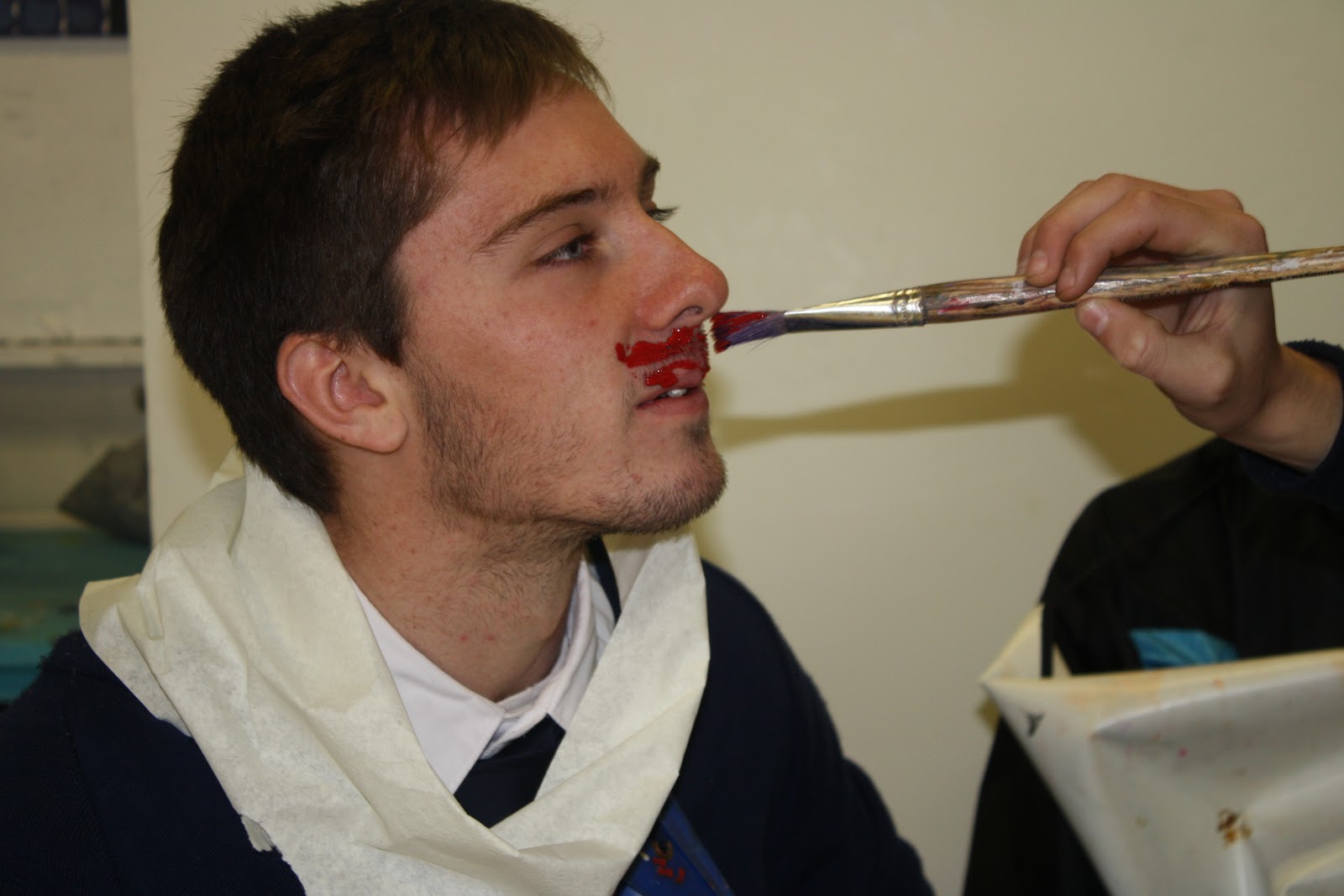


With some work in photoshop, we added some text and ended up with this .....................................


Friday, May 24, 2013

Just one of the Gang

After a few days at school, Archie was taken out for lunch in the playground and spent some time hanging out with new friends. There were some sheep on the oval in the distance. Archie will have plenty of time to catch up with them a bit later. 


Heading down the hall with the help of Renee, Katie and Angela.


now, who's being silly!


     How Relaxing
ALWAYS look after the environment. Rubbish in the bin.